Multi-repository workflow
Audience: project maintainers and authorized agents configuring an installation. For the everyday workflow, start with Quickstart.
Use this guide when one change writes code in several repositories, or when a test runs in one repository but needs code or contracts from others.
If the change needs only one repository, stop here: the normal Quickstart already covers the simpler path.
A scenario: one change across an API repo and a web repo
Section titled “A scenario: one change across an API repo and a web repo”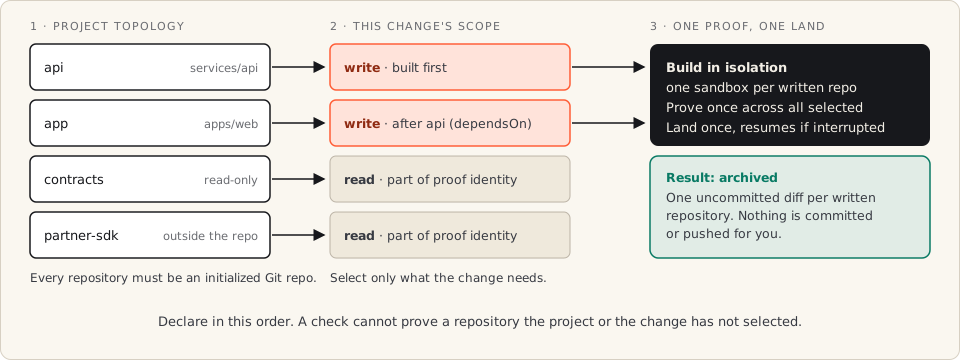
You ask for a new field on the profile page. The API repository must return it,
and the web repository must show it. A shared contracts repository describes
the response shape and must not be edited.
The decision: declare scope first. Before Build, say (or confirm) which
repositories this change may write (api, app), which it may only read
(contracts), and what must happen first (api before app). Change Loop will
not touch, test against, or deliver any repository outside that declaration.
What you see:
- The agent’s statement of scope before you approve: repositories written, repositories read, and their order.
- Build and Prove progress per repository. The web checks run against the API’s new, not-yet-delivered code, because both live in isolated sandboxes.
- At the end, a result that names which repositories were read, written, proven, and still waiting to Land.
What you decide:
- Confirm the repository scope and order (the one consequential choice).
- Approve the agreement, as for any change.
- Say
/landonce. Every writable repository then receives its changes as an uncommitted diff; Git HEAD and index stay unchanged everywhere. You review each diff and commit through your normal Git process. Onlyarchivedmeans done;provendoes not.
If a read repository moves while you work, the agent re-syncs and re-proves automatically. You do not run sandbox or sync commands.
Everything below is the mechanics the agent and project maintainers use.
For agents and integrators
Section titled “For agents and integrators”First, understand the three scopes
Section titled “First, understand the three scopes”These files answer different questions. Configure them in this order:
| Order | Contract | Question it answers |
|---|---|---|
| 1 | openspec/repositories.yaml |
Which repositories may this project use? |
| 2 | openspec/changes/<change>/repositories.yaml |
Which of them may this change read or write? |
| 3 | derived provider or conditional execution.yaml fields |
Which repositories does this evidence command need? |
Do not skip directly to provider wiring. A provider cannot prove a repository that the project topology does not know or the change did not select.
1. Declare the project topology
Section titled “1. Declare the project topology”Add every repository Change Loop may isolate to openspec/repositories.yaml:
{ "version": 1, "repositories": [ { "id": "api", "path": "services/api", "setupCommand": "npm ci" }, { "id": "app", "path": "apps/web", "setupCommand": "npm ci" }, { "id": "contracts", "path": "contracts", "mode": "read" }, { "id": "partner-sdk", "type": "external", "path": "../partner-sdk", "mode": "read", "allowOutsideRoot": true } ]}What matters:
idis the stable name used by tasks, providers, receipts, and Land.pathis relative to the control repository.setupCommandprepares that repository’s newly created worktree.- a path outside the control repository, such as a sibling
../sdk, must declareallowOutsideRoot: true. Itstypemay staygit(the default) or beexternal; both behave the same. A writable sibling owns tasks and Lands like a submodule; - every selected repository must already be an initialized Git repository.
Change Loop refuses a non-Git dependency because it cannot pin or isolate a moving directory honestly.
Check the result before creating a change:
claude-foundation repos2. Select the change scope
Section titled “2. Select the change scope”Inside the change, select only the repositories it needs:
{ "version": 1, "repositories": [ { "id": "api", "mode": "write", "dependsOn": [] }, { "id": "app", "mode": "write", "dependsOn": ["api"] }, { "id": "contracts", "mode": "read", "dependsOn": [] }, { "id": "partner-sdk", "mode": "read", "dependsOn": [] } ]}Use write only where the change will produce code. Use read for test data,
contracts, SDKs, and integration dependencies. A read repository is part of
proof identity, but it is not a Build or Land target.
Selecting any non-root repository makes the lifecycle composite. This includes
a selection with exactly one child and no root product work; it must not be
downgraded to the single-root Apply or archive path.
Then inspect the resolved selection:
claude-foundation repos <change>3. Bind tasks to repositories
Section titled “3. Bind tasks to repositories”Every implementation task names its owning repository and paths. Dependencies make cross-repository order explicit:
- [ ] **T001** Update API [repo:api] [kind:implementation] [paths:src/profile]- [ ] **T002** Update app [repo:app] [kind:implementation] [depends:T001] [paths:src/profile]- [ ] **T003** Verify contract [repo:app] [kind:contract] [depends:T001,T002]Change Loop compiles repository selection, tasks, providers, and Land order into the execution graph. Do not create a second graph file.
4. Let Build create all sandboxes
Section titled “4. Let Build create all sandboxes”The normal agent command creates the selected workspaces together:
claude-foundation advance <change> --through buildsandbox create --all and sandbox inspect remain operator diagnostics under
help --all; users do not need to sequence them.
After isolation, every selected child must have a runtime record matching its
catalog target, access mode, base head, and live worktree. sandbox inspect
lists missing-record, unexpected-record, missing, or invalid instead of
silently substituting the target checkout. Inspection reads filesystem and Git
metadata directly, so a repository-controlled git on PATH is never run.
Write repositories receive isolated Build worktrees. Git-backed read and external repositories receive pinned detached worktrees. The command does not make an external service or arbitrary folder safe; this is Git workspace isolation, not an OS security boundary.
Root code and tests can still use a nested repository through its root path,
for example require('./packages/lib'). In the root sandbox the harness links
a selected repository’s path to that repository’s sandbox, so root checks see
its uncommitted work and an edit through either path lands in the same place.
An unselected nested repository holds the commit the root gitlink records,
checked out from local objects even when the target never initialized it, and
is read-only. These paths are never root changes: they stay out of root proof,
review, the changed surface, and Land. Nobody needs to create a link or
initialize a submodule by hand.
5. Wire repository-scoped evidence
Section titled “5. Wire repository-scoped evidence”For custom wiring in conditional execution.yaml, repository is the provider’s working directory.
repositories is the complete set the command reads:
{ "providers": { "integration": { "capability": "integration", "adapter": "command", "repository": "api", "repositories": ["api", "app", "contracts", "partner-sdk"], "command": ["npm", "run", "test:integration"] } }}Change Loop passes two relevant environment variables:
FOUNDATION_REPOSITORY_ID— the working-directory repository ID;FOUNDATION_REPOSITORIES_FILE— a versioned JSON manifest mapping every scoped ID to its isolatedpath,access, andbaseHead.
Changed-surface checks, review packets, provider manifests, snapshots, and Land use this same recorded base. Before isolation the selected source head may seed the record; after isolation a missing child binding is infrastructure failure.
Provider code must read the manifest. It must not assume all five company repositories happen to be checked out as siblings on the current machine.
The repository set is part of command deduplication and receipt identity. Two
identical commands with different repository sets execute separately, and each
receipt records its complete repositoryIds.
6. Build and synchronize
Section titled “6. Build and synchronize”Plan parallel workers only after scope and dependencies are stable:
claude-foundation agents plan <change>If another change advances a selected repository, advance synchronizes the
sandbox itself before Prove; sandbox sync <change> is the diagnostic
primitive behind it. Sync refreshes child read worktrees even when the control sandbox uses copy
mode. A repository setupCommand runs again after refresh. If setup or a
provider leaves a tracked change in a read workspace, readiness fails closed.
7. Prove the complete graph
Section titled “7. Prove the complete graph”claude-foundation advance <change> --through provenproof readiness and proof run remain diagnostic primitives. Prove may run independent branches concurrently and preserve completed branches
after a failure. Aggregate proof still requires every selected repository and
provider scope to match the current graph. A moved read dependency requires
sync and fresh proof; Change Loop never certifies the old commit under the new
repository manifest.
Consumer quality follows the same graph but never averages repositories. Add a
row for every selected repository to quality/foundation-quality.json; a
selected repository missing from that file fails closed. Each lane keeps its
own commit, workspace digest, tool/config identity, baseline, and assurance.
Use quality run --change <change> before Prove or let evidence bootstrap wire
the committed quality config as static-analysis evidence. See
Consumer quality gates.
8. Land every writable target uncommitted
Section titled “8. Land every writable target uncommitted”Read repositories have no Land node. One explicit user command grants the complete local delivery transaction:
/land <change>The harness prepares every writable target before the first write, then applies
the explicitly authorized projections in dependency order with durable checkpoints. Each node
finishes applied-uncommitted; Git HEAD and the index remain unchanged in every
repository, and existing non-overlapping edits are preserved. A later /land
resumes the same transaction and skips verified nodes. land check, legacy
land record, and land resume remain diagnostic/compatibility primitives—not
steps the user must sequence. Commits, pushes, and pull requests stay outside
Land under separate user authority.
The saga is also required when exactly one non-root child is selected. A missing child runtime record cannot make Land take the single-repository shortcut.
Recovery map
Section titled “Recovery map”| What happened | Correct next action |
|---|---|
| A selected target moved | advance synchronizes the sandbox and proves again |
| Sync reports a replay conflict | The agent resolves the named paths in the sandbox; do not recreate the change |
| A read repository is dirty | Remove the mutation or fix setup/provider behavior |
| Repository setup failed | Harness retries only that repository and preserves ready siblings; change policy only if the declared command itself is wrong |
| A selected child binding is missing | Harness repairs the binding while preserving valid worktrees; use sandbox inspect only for requested diagnosis |
| A canonical child path belongs to another repository | Keep it untouched, inspect the reported path, then correct the target/path conflict or explicitly abandon the change |
| Provider cannot see a repository | Add it to provider repositories; do not hard-code a local path |
| A check refuses because an unselected repository’s root copy changed | Revert that copy (the refusal names the command), or select the repository through a semantic amendment |
| Land is interrupted | Invoke /land <change> again; it resumes the journal and re-applies root or repository sandbox work added after an earlier delivery |
Land stops with ROOT_POINTER_MOVED |
The root sandbox moved the pointer of a selected submodule: the agent brings the commit into that repository’s sandbox, restores the root pointer, and resumes |
Land stops with repository-pointer-change |
The root sandbox moved the pointer of an unselected submodule: the user chooses to land it through that repository, restore the pointer and land the rest, or pause |
What the user and agent each need to do
Section titled “What the user and agent each need to do”User: confirm consequential repository scope/dependency semantics, invoke Land once, review the final diffs, and commit through the project’s normal Git process. You do not construct manifests, grants, receipts, hashes, or journals.
Agent: configure the three scopes in order, use the manifest paths, run readiness before spending a Prove attempt, follow the reported recovery, and state which repositories were read, written, proven, and still waiting to Land. Do not ask the user to copy protocol JSON or silently reduce a five-repository test to the three repositories present in the sandbox.