Files, readers, and ownership
Audience: project users. This guide explains what to review and decide; the agent handles routine system operations.
Change Loop adds files to your repository. This page tells you which ones you own and review, which ones Change Loop replaces on upgrade, which ones the harness writes as it works, and which ones to leave alone. You review the intent and the result; you never maintain internal state.
Which files are mine?
Section titled “Which files are mine?”| Group | Files | What you do |
|---|---|---|
| Yours (committed, preserved on upgrade) | openspec/specs/, openspec/changes/, openspec/investigations/, foundation.json, openspec/config.yaml, openspec/repositories.yaml, quality/, CLAUDE.md, AGENTS.md, .claude/settings.json |
Review and decide. Ask the agent to change agreements through the supported workflow |
| Installer-managed (replaced on upgrade) | .claude/orchestrator.md, .claude/commands, .claude/harness, .claude/skills, .claude/rules, .claude/hooks, openspec/schemas, WORKFLOW.md, .foundation/.gitignore, .foundation/README.md |
Read as reference. Customize through your own configuration, not by editing these |
| Generated by the harness (ignored by Git) | .foundation/runtime/, receipts/, evidence/, transactions/, logs/ |
Read for diagnosis. Never edit them to change a verdict, and never treat them as disposable |
| Working files | .foundation/drafts/, code in .foundation/sandboxes/ |
The agent writes them. Review the compiled agreement and the final diff |
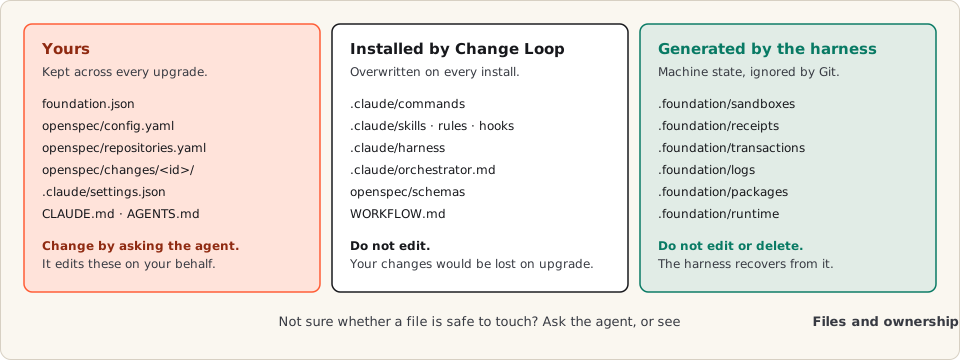
your-project/├── foundation.json YOURS policy: budgets, models, review, setup├── CLAUDE.md, AGENTS.md YOURS your project instructions├── quality/ YOURS optional quality gate configuration├── WORKFLOW.md MANAGED lifecycle reference├── .claude/ MANAGED harness, commands, skills, rules, hooks│ (your own settings.json is yours)├── openspec/│ ├── specs/ YOURS what the landed system is held to│ ├── changes/<id>/ YOURS the agreement for one active change│ ├── investigations/ YOURS findings from /investigate│ └── schemas/ MANAGED replaced on every install└── .foundation/ GENERATED runtime state, receipts, evidence, sandboxes (may hold unlanded code)Do not delete .foundation/ to reset work. Ignored by Git does not mean
safe to delete: it can hold unlanded code, evidence history, recovery journals,
and backups. Ask the agent to use the supported recovery or cleanup flow.
Project-owned does not mean hand-edited mid-change either: the harness
maintains generated links, task IDs, and checkboxes, so ask the agent to revise
or amend. Terms used below, such as receipt and sandbox, are explained in the
glossary.
For agents and integrators: ownership detail
Section titled “For agents and integrators: ownership detail”File ownership and intended reader are different things. A project-owned agreement can be compiled by the harness, and an agent can write project-owned code.
What belongs to whom?
Section titled “What belongs to whom?”| Category | Examples | Your role | Writer and upgrade behavior |
|---|---|---|---|
| Project agreement | openspec/specs/, openspec/changes/, openspec/investigations/ |
Review behavior, scope, decisions, and outcomes | Agent authors inputs; harness compiles and updates the packet. Installer preserves it |
| Project configuration | foundation.json, openspec/config.yaml, openspec/repositories.yaml, quality/ |
Choose project policy; ask the agent to configure it | Project maintainer or authorized agent; installer seeds/merges supported configuration |
| Project instructions | CLAUDE.md, AGENTS.md, .claude/settings.json |
Keep your project’s instructions and preferences | Installer updates marked pointer blocks and merges supported host settings, not whole project instructions |
| Installed Change Loop files | WORKFLOW.md, .claude/harness/, managed commands/skills/hooks, openspec/schemas/ |
Read as reference; customize project configuration instead | Change Loop maintains these; upgrades refresh managed files |
| Runtime records | .foundation/runtime/, receipts/, evidence/, transactions/ |
Read diagnostics if needed; do not edit records to change a verdict | Harness and configured tools write these through supported operations |
| Temporary inputs and working code | .foundation/drafts/, declared sandbox code/test paths |
Review the compiled agreement and final diff | Agent writes inputs and implementation; sandbox work may not yet be delivered |
In the Change Loop source repository, root CLAUDE.md and AGENTS.md guide
maintainers. In your installed project, files with those names remain your
project instructions. Repository tests, reports, and the documentation website
are upstream maintenance material, not prerequisites for using Change Loop.
The system ownership reference
defines the full categories and writer rules; your installed copy is at
.claude/harness/README.md. The installer’s MANAGED list and your
.foundation/install-manifest.txt determine installed-file ownership.
The openspec/ tree
Section titled “The openspec/ tree”openspec/├── config.yaml project OpenSpec configuration and authoring rules├── repositories.yaml repository topology and per-repository CI issuers├── specs/ the requirements the landed system is held to├── changes/│ ├── <change-id>/ one active change packet│ └── archive/ landed packets, dated├── investigations/ durable findings from /investigate└── schemas/ the two assurance profiles and their templatesOwnership is not uniform across that tree, and it decides what an upgrade may overwrite:
| Path | Owner | On install |
|---|---|---|
schemas/ |
Change Loop | Overwritten every install. Edit a profile here and the next upgrade discards it |
config.yaml |
your project | Copied only when missing, yours afterwards |
repositories.yaml |
your project | Copied only when missing, yours afterwards |
specs/, changes/, investigations/ |
your project | Never touched by the installer |
foundation.json sits at the repository root rather than in openspec/,
because it holds project policy rather than intent: execution budgets, packet
size caps, model tiers, escalation triggers, the review diversity and
independence settings, and the sandbox setup command (sandbox.setupCommand)
that runs once inside every new Build workspace.
It is seeded when missing and remains project-owned. Upgrades can add missing
fields and migrate recognized legacy defaults while preserving custom policy.
See Configure foundation.json for policy fields, current defaults, and review settings. This page describes ownership rather than duplicating those defaults.
Consumer quality adds another committed, project-owned tree:
quality/├── foundation-quality.json repository profiles, providers, thresholds, exceptions└── baselines/ ├── manifest.json decision references and baseline provenance └── <repository>/ versioned CRAP and mutation reportsquality init previews this configuration before writing it. Baselines are
never created implicitly: quality baseline --write requires both a decision
reference and a reason. See Consumer quality gates.
config.yaml is worth reading once. It carries the default schema plus the
authoring rules every change inherits — what a proposal must state, that specs
use stable names and WHEN/THEN, that design records only decisions constraining
implementation or rollback, and that tasks.md stays a single ledger. Changing
it changes what the harness asks of every future change.
The change packet
Section titled “The change packet”One directory per active change, at openspec/changes/<change-id>/. This is
what a reviewer reads.
| File | What it holds | Profile |
|---|---|---|
proposal.md |
Summary, why, user stories, success criteria, a capability index, what observably changes, impact, and non-goals; discovery coverage as an appendix | both |
tasks.md |
The sole implementation ledger — the only place work is tracked | both |
evidence.yaml |
The stable behavioral contract: claim IDs, scenarios, capabilities | both |
grounding.yaml |
Semantic v3 non-derived material decisions; legacy read-set grounding remains readable | conditional when a decision must be locked |
execution.yaml |
Replaceable custom wiring: provider commands, services, readiness | conditional when derived wiring is insufficient |
repositories.yaml |
Explicit repository selection and write modes | conditional for multi-repository scope |
handoffs.yaml |
Permission-bound external operations and activation safety | conditional when such work exists |
.openspec.yaml |
Which assurance profile governs the packet | both |
design.md |
Overview, assumptions and open questions, typed blueprints, a task overview, durable decisions (including settled intake answers), diagrams, integrations, compatibility, and risks; empty sections are omitted | standard, conditional on design context |
specs/**/spec.md |
Requirement deltas — ADDED, MODIFIED, REMOVED |
both (rapid: concise; absent only in legacy skip_specs packets) |
A foundation-rapid packet has a concise spec delta, merged into openspec/specs
at Land, and normally omits design.md; agent defaults appear under Decisions
in its proposal. The moment
impact rises above low, coupling stops being isolated, or review or acceptance
becomes required, the change upgrades itself to standard and its delta
artifacts are created for you. Optional extensions still appear only when their
concern exists.
The agent does not author cross-ledger IDs by hand. The current semantic draft compiles requirements, scenarios, tasks, claims, and provider bindings into this packet. That compiled OpenSpec packet remains the source of truth. A selected prototype or diagram may be referenced from design, but prototype output is still non-authoritative and is rejected as evidence.
Project-owned does not mean hand-edited during an active change. Ask the agent to revise or amend the agreement through the supported workflow. The harness maintains generated links, task IDs, and completion checkboxes. Review these files; do not tick tasks or rewrite generated packet fields to bypass checks.
Machine state
Section titled “Machine state”Generated records are ignored by Git. The installed .gitignore and README
are product files. Agent-written drafts and sandbox code are working inputs;
optional .foundation/policy.json is project-authored capability policy.
These exceptions do not permit manual edits to receipts or lifecycle state.
For the complete state inventory, use the installed Runtime state reference. It lists generated records, caches, working inputs, and their purposes.
The sections below explain the evidence and archive records you may need to review; they are not instructions to edit runtime files.
The evidence vault
Section titled “The evidence vault”receipts/ holds the live receipt for each provider, which is overwritten
every time that provider runs. evidence/ holds the immutable copy taken at
the moment proof was finalized:
.foundation/evidence/<change-id>/ <proof-run-id>/ manifest.json the proof, copied verbatim receipts/<provider>.json each receipt, with sha256 and byte size artifacts/<provider>/<digest>-<name> logs, reports, traces, screenshots review-attempts/ 0001-<digest>.json hash-chained review ledgerEvery copied receipt and artifact is bound by SHA-256 and byte size.
proof audit re-reads them and fails if either has moved. An artifact that
lives outside the vault is not admissible, which is why a durable report is
copied in rather than referenced where it was produced.
The review-attempt ledger is a hash chain. A broken link is never treated as
an empty history: the harness moves the ledger aside as
review-attempts.corrupt-<stamp> and rebuilds it without asking you. The
rebuilt count never drops below the attempts on record, and an attempt that
no longer verifies counts as a spent review wave rather than a reusable verdict.
The archive
Section titled “The archive”Landing moves the packet to openspec/changes/archive/<YYYY-MM-DD>-<change-id>/
with the same files intact, and merges the requirement deltas into the durable
specs at openspec/specs/<capability>/spec.md.
The merge is verified rather than trusted: Change Loop re-derives the before, after, and delta states and blocks the land if the archived specs do not match what the deltas said they would produce.
Artifacts that are deliberately not evidence
Section titled “Artifacts that are deliberately not evidence”Two kinds of output exist to help you think, and neither can be cited as proof.
Prototypes written to .foundation/prototypes/<id>/ during a comparison
investigation are explicitly rejected as evidence artifacts or references. A
prototype demonstrates that an approach is possible; it does not demonstrate
that the shipped code works.
Investigation records at openspec/investigations/<id>.json hold typed,
source-linked facts, hypotheses, decisions, and the conclusion. Optional notes
at openspec/investigations/<name>.md add human narrative. Machine state and
handoff digests live under .foundation/investigations/; they are derived and
ignored. The project-owned record and note are
committed and reviewable, and they rank below specs and code when the three
disagree — a note records what was believed at the time, not what is true now.
Telemetry
Section titled “Telemetry”Each command appends a row to .foundation/logs/<change-id>/operations.jsonl,
alongside context events and phase-context records. telemetry reports totals,
estimated tokens, and duration percentiles by kind. Scheduler rows expose
queueing, reuse, executed nodes, and peak concurrency for harness-owned waves.
The accounting deliberately distinguishes unknown from zero. A run whose cost could not be measured is reported as unmeasured rather than free.