Claims and capabilities
Audience: coding agents and integration operators. CLI commands and schemas below are system reference, not a user checklist. Users can follow Quickstart.
In plain words: a claim is a promise the change makes about behavior, a capability is a kind of check that can show it (test, browser, accessibility), a provider is the project tool that runs that check, and a receipt is the recorded result. This page is for agents and integrators declaring what a change must prove. You need a change with acceptance scenarios; you get a claim list that decides which checks must pass before Land. See the glossary.
Change Loop’s central rule: a passing command is not automatically proof.
Every observable acceptance scenario gets a stable claim ID. Each claim declares the capabilities that could actually demonstrate it. Missing, stale, failed, erroneous, or inconclusive evidence blocks landing.
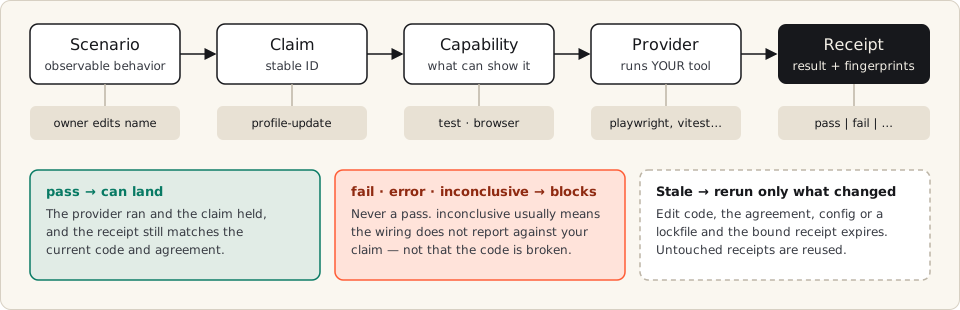
The behavioral contract
Section titled “The behavioral contract”evidence.yaml holds the stable part. It changes only when observable claims or obligations change:
{ "version": 2, "claims": [ { "id": "profile-update", "scenario": "The owner can update their profile", "impact": "medium", "capabilities": ["test", "browser", "accessibility"] } ]}Semantic draft v3 derives ordinary provider wiring from task verification and
stores it with the contract in evidence.yaml. Custom commands, reports,
services, or readiness overrides live separately in conditional
execution.yaml. Rewiring still does not change
what the software promises.
The capability catalog
Section titled “The capability catalog”Select only what the claim needs — never the full catalog by default.
| Capability | What it asserts |
|---|---|
test |
Executable behavioral checks for the declared claim |
discovery |
Expected tests were found and the discovered count meets the floor |
browser |
Rendered behavior in a real browser with the required input capability |
mutation |
A deliberate behavioral fault is detected by the evidence suite |
state-identity |
State before, during, or after belongs to the intended actor and revision |
integration |
Multiple components or external boundaries work together |
compatibility |
Public or persisted contracts remain compatible across supported versions |
performance |
Measured latency, throughput, resource, or size budgets are met |
concurrency |
Concurrent and asynchronous paths keep their ordering, isolation, and completion guarantees under contention |
security-static |
Static security checks cover the changed trust boundary and unsafe sinks |
cross-repo-contract |
Producer and consumer repositories agree on the same versioned contract |
review |
Independent risk review covers the declared claims and unresolved findings |
acceptance |
A named human accepts an explicitly subjective product or experience decision |
static-analysis |
Compilation, type checking, linting, and static quality gates pass |
data-migration |
Schema or data evolution is forward-safe, backward-compatible, rollback-aware |
accessibility |
Rendered semantics, keyboard use, focus, contrast, assistive access meet policy |
resilience |
Timeout, retry, partial-failure, recovery, degraded-dependency behavior is proven |
observability |
Required logs, metrics, traces, and alerts expose success and failure safely |
deployment |
Packaging, configuration, rollout health checks, and rollback behavior are proven |
dependency-supply-chain |
Dependency vulnerability, license, lockfile, and provenance policy passes |
evaluation |
A model or ranking evaluation scores at or above its threshold |
parity |
The new implementation matches the reference on the declared comparison set |
plan-check |
An infrastructure or migration plan contains only the declared changes |
release-health |
Crash, error, and adoption signals stay healthy during rollout (post-release) |
experiment-guardrail |
Guardrail metrics stay within bounds after release (post-release) |
Twenty-five capabilities. Most changes use two or three. The last two are
post-release rollout gates: they are listed in the archived proposal and never
block proof or Land. The work types that require the specialist capabilities
(for example ml → evaluation, infra → plan-check) are listed in the
evidence contract.
A security-static, resilience, compatibility, data-migration, or
cross-repo-contract provider that only re-runs the test command observes
nothing beyond the tests, so it is never run or credited. The required review
covers that capability instead, at a higher tier, and the proof records it as
covered-by-review. Wire a real command for the capability to observe it
directly.
Receipts
Section titled “Receipts”A receipt is what a capability produces. It binds to everything that could invalidate it:
provider browseradapter playwright · protocol 7execution harnessclaims profile-view, profile-updateworkspace sha256:7f31…environment node 22 · darwin-arm64input browser-automationartifacts trace.zip · screenshot.pngduration 8.42sChange a bound input and the receipt becomes stale. Change Loop never silently reuses mismatched evidence.
execution: harness is set only by a call site that actually ran a command. See /prove for the full floor on hand-recorded evidence.
Test and discovery
Section titled “Test and discovery”The configured structured JSON report must expose a non-negative integer such as numTotalTests, totalTests, testCount, or expected.
If the command passes but no deterministic count is available, test evidence may pass while discovery is inconclusive — and landing stays blocked. Arrays, numeric strings, arbitrary nested keys, and mixed stdout are not coerced into a count. A suite that silently discovered zero tests is exactly the failure this catches.
Traceability
Section titled “Traceability”claude-foundation change audit <change>Audits scenario → claim → task → provider traceability. Every observable scenario should reach a claim, and every claim a provider that can demonstrate it. A scenario with no claim is a promise nobody is checking.